
Los Angeles County Criminal Court Cases
Felony and misdemeanor filings in Los Angeles County are records of the Superior Court of California, County of Los Angeles. The Criminal Division handles arraignments, pretrial hearings, trials, sentencing, post-conviction matters, and specialty calendars. The clerk keeps the register of actions and filed documents. An arresting agency still keeps its own incident report, while California DOJ keeps the controlled state summary criminal history.
Location matters. The court directory includes the Central Arraignment Courthouse, Clara Shortridge Foltz Criminal Justice Center, Mental Health Courthouse, Airport, Compton, Inglewood, Long Beach, Pasadena, Pomona, Torrance, Van Nuys, West Covina, and other sites. A case number and courthouse name are the safest keys for finding the correct Los Angeles County criminal court file.
Los Angeles Criminal Defendant Index
The LASC Criminal Defendant Index helps a reader locate a criminal case number by defendant name. A separate Criminal Case Access screen accepts a known case number. Name searches are useful when paperwork is missing, but shared names can produce uncertain matches. Remote results may omit a birth date and other sensitive identifiers.
The online entry is not the official court record. Confirm the result against the clerk's file before relying on a charge, hearing, warrant event, or disposition. The manifest image below comes from the court's official defendant-index page.
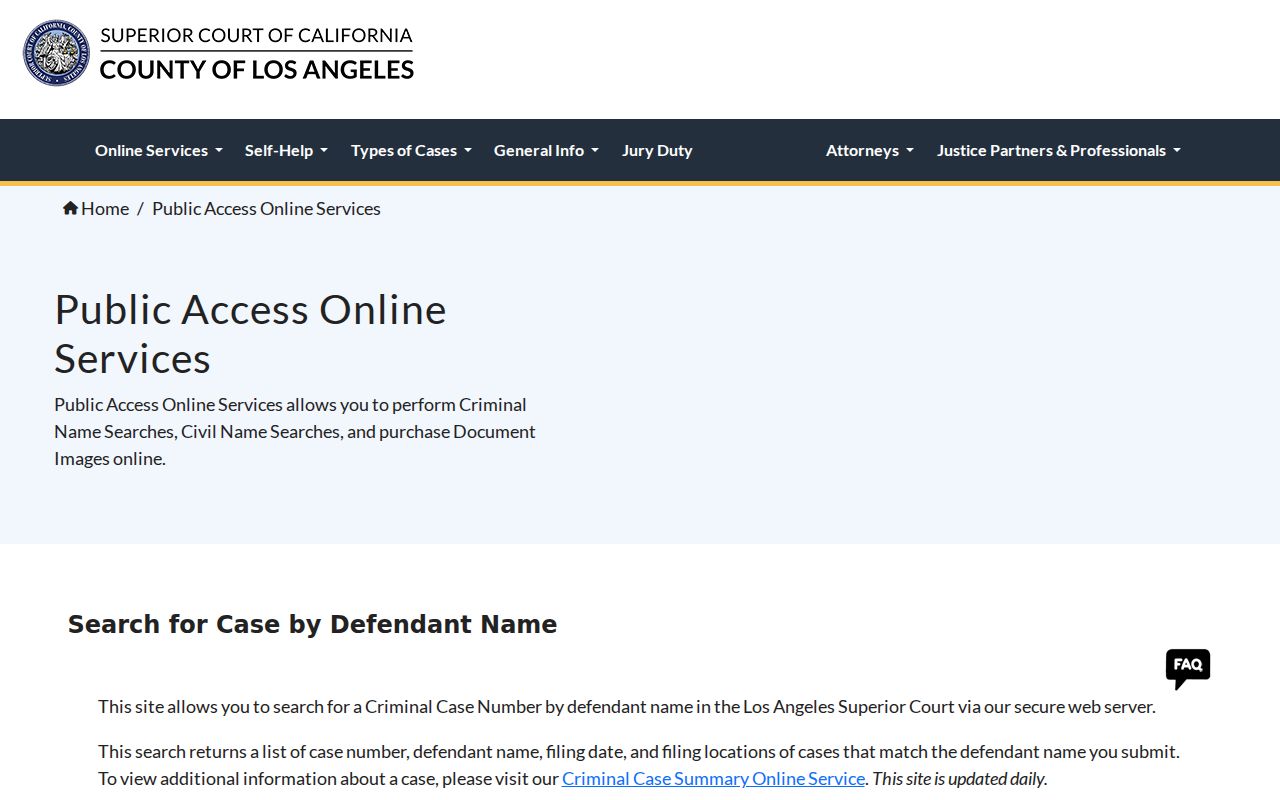
The index is best treated as a locator that supplies the number needed for a focused clerk request.
Searching Los Angeles County Case Records
Use the Superior Court web tools first, then verify at the criminal clerk's office. Older Los Angeles County files may require the Archives and Records Center route rather than the current online index.
- Open Criminal Case Access or the Criminal Defendant Index.
- Search by defendant name to find a number, or enter the known case number.
- Match the courthouse, filing details, and public party data before selecting a result.
- Read the register of actions in date order, noting that online data is not official.
- Give the case number to the clerk when requesting copies, certification, or archive help.
| Field Label | Type | Required | Notes |
|---|---|---|---|
| Defendant Name | Text | Yes for name index | Used to locate a case number; birth data may be withheld remotely. |
| Case Number | Text | Yes for case lookup | The direct and most reliable search key. |
| Search | Button | Yes | Runs the selected query. |
| Disclaimer | Notice | Required by use | Online data must be checked against the official file. |
Los Angeles Criminal Courthouse Routes
The main downtown court is the Clara Shortridge Foltz Criminal Justice Center at 210 W. Temple Street, Los Angeles, with listed site hours of 8:30 a.m. to 4:30 p.m. on weekdays. Central Arraignment sits at 429 Bauchet Street. The Long Beach Courthouse serves its district, while Santa Clarita criminal intake is at 23747 W. Valencia Boulevard.
The county locator's Foltz listing is the source for the first courthouse image.
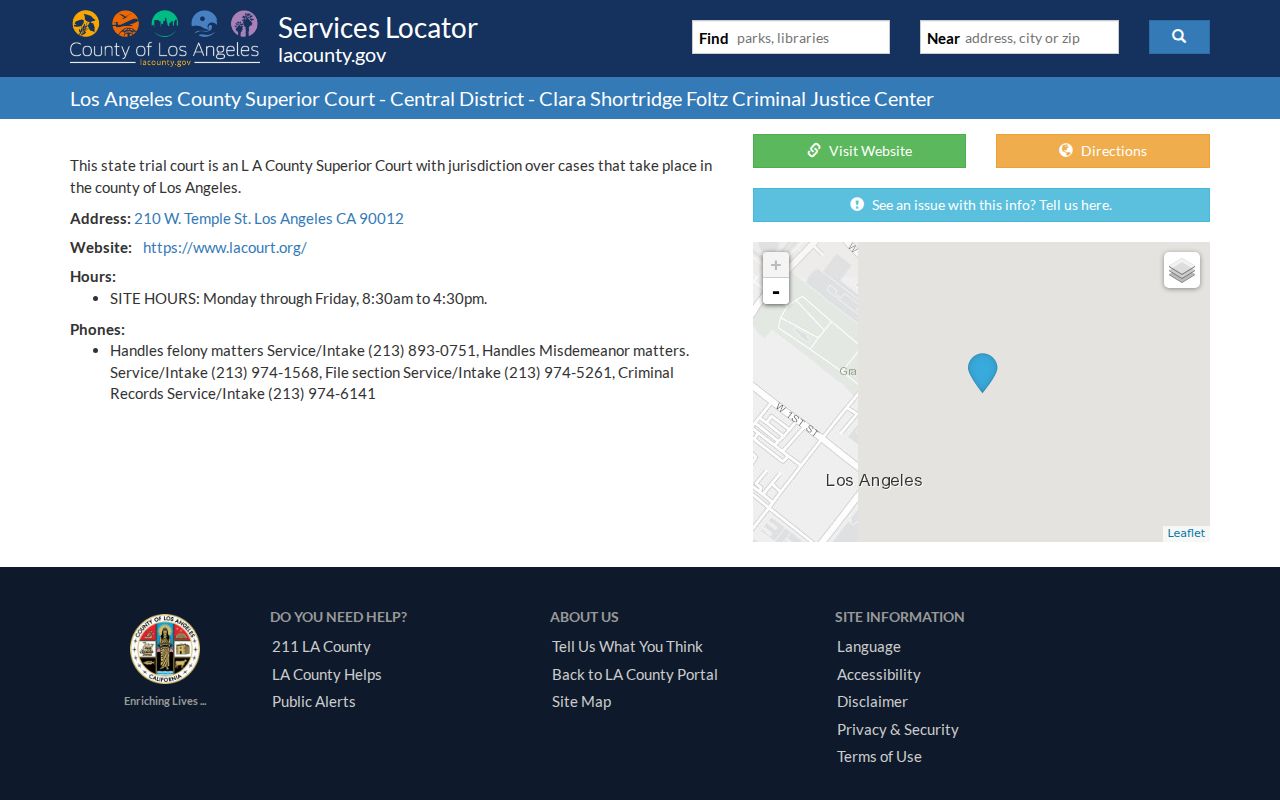
The listing helps confirm the court's address and public counter hours before a records visit.
For northern county routing, the Santa Clarita Courthouse locator identifies its criminal service counter and phone, (661) 253-7384.
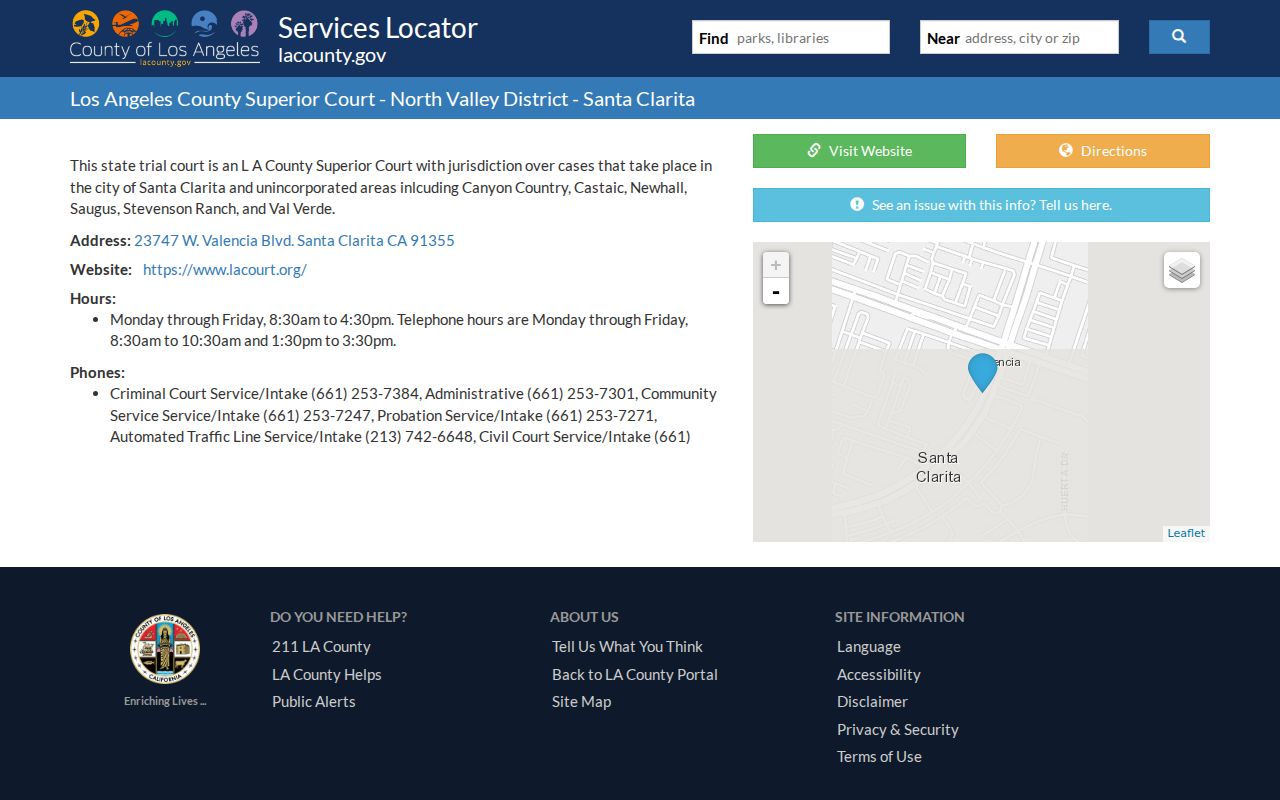
This local route prevents a trip to downtown when the case belongs to the North Valley District.
Inside a Los Angeles County Case File
A Los Angeles County case file shows what prosecutors filed and what the judge did. Charges at booking may differ because the prosecutor can add, reduce, or decline counts. Read each count and its final disposition, rather than treating the first charge as the outcome.
| Case Number and Court | Identifies the file, district, case type, and assigned courthouse. |
|---|---|
| Charging Document | The complaint, information, or indictment lists filed counts. |
| Docket Entries | The register of actions tracks hearings, motions, pleas, and orders. |
| Hearing Dates | Shows past events and future settings when public. |
| Disposition and Judgment | Records conviction, acquittal, dismissal, or other result by count. |
| Sentence and Conditions | May state custody, probation, fines, restitution, or other orders. |
Reading Los Angeles Case Dispositions
A disposition is the result of a count. Dismissal means the court ended that count without a conviction. Acquittal follows a not-guilty result. A plea is the defendant's formal answer, and a minute order is the clerk's summary of a hearing. None of those terms alone means that the public record was sealed.
- Register of actions
- The dated list of court events.
- Disposition
- The outcome attached to a charge or case.
- Minute order
- The clerk's short record of an order or hearing.
- Sealing
- A legal limit on public access, distinct from dismissal.
The Los Angeles County Public Defender may appear as counsel on a case. Its official site supplied the next assigned image.
Counsel information helps explain representation, but the clerk's docket remains the source for the court result.
How a Los Angeles Criminal Case Moves
A court file begins when a complaint, information, or indictment is filed. Arraignment is the first court event where charges are read and plea and release issues are addressed. Pretrial litigation can include evidence motions, a preliminary hearing in a felony matter, negotiations, and specialty-calendar review. A plea or trial resolves the filed counts. Sentencing follows a conviction, while a dismissal or acquittal ends the affected count without conviction.
Case flow: Charges Filed › Arraignment › Pretrial › Plea or Trial › Disposition › Sentencing
Los Angeles Disposition Reporting Gap
A 2026 Superior Court notice reported a backlog of about 464,000 Arrest Disposition Reports affecting roughly 408,000 people. Those reports carry court outcomes back to California DOJ. The gap explains why a current court file and a state rap sheet may not match at the same moment.
If an own-record review lacks a Los Angeles County disposition, obtain the official court record first and follow DOJ's correction instructions. Do not assume that a blank or stale state entry changes what the court ordered.
Los Angeles Archived Case Routes
Not every Los Angeles County criminal court file is fully available through the current web index. The Superior Court routes older material through its Archives and Records Center, while current public summaries remain tied to the courthouse and case number. A reader who finds no complete online history should first confirm the filing court, then ask the clerk whether the file is active, archived, sealed, or available only through an in-person or mail request.
This distinction matters for genealogy, personal record review, and older disposition research. A missing remote result does not prove that no case existed. Give the clerk the defendant name, known case number, approximate filing period, and courthouse when those facts are available. Certified copies must come from the court rather than the public index.
Case Record Access and Restrictions
California Rule of Court 2.503 governs reasonable electronic access, but sealed matters and confidential fields stay restricted. Remote Los Angeles County views may suppress birth dates, victim and minor names, Social Security numbers, medical information, and other protected data. Juvenile matters are not treated as ordinary public adult criminal files.
When a case does not appear, check spelling and the case number, then contact the clerk at the courthouse shown on the notice. Archives may hold older files. Court copies, not the web summary, establish the official record. Arrest and custody details belong to LASD or the arresting agency, while a broader journey from booking to court is covered in the Los Angeles County arrest lookup.