
Checking Criminal History in Santa Clarita
The first Santa Clarita step is to identify the custodian. Local law-enforcement questions begin with the Santa Clarita Valley Sheriff’s Station. Formal LASD report or custody requests may move to a department records or CPRA channel. Court events belong to LASC, while the City Clerk portal covers City Hall records rather than sheriff criminal reports.
- Call or visit the Santa Clarita Valley Sheriff’s Station for station-level incident questions.
- Use LASD Records and CPRA routes when a formal report or custody copy is needed.
- Search LASD Inmate Information Center for recent county custody.
- Contact Santa Clarita Courthouse or search LASC for a filed criminal case.
- Use California DOJ Live Scan Record Review only for your own official state history.
This sequence keeps a Santa Clarita request out of the wrong portal. The Los Angeles County criminal-history overview supplies broader county and state detail after the local route is clear.
Santa Clarita Uses a Sheriff Station
Santa Clarita is a contract city. LASD’s Santa Clarita Valley Sheriff’s Station provides the city’s general law-enforcement service rather than a municipal police department. The station also serves nearby communities and destinations, including Canyon Country, Castaic, Newhall, Saugus, Valencia, Stevenson Ranch, and Six Flags Magic Mountain. That larger service area makes precise location information useful in any request.
The contract arrangement changes the records path. A Santa Clarita criminal incident is a sheriff record, even when it occurred within city boundaries. City Hall cannot substitute for LASD when the request seeks an arrest report, investigative material, or sheriff call information. The contract-city distinction is the central fact behind every local search.
Santa Clarita Police Department Records
Santa Clarita has no municipal police department for general policing. The Santa Clarita Valley Sheriff’s Station is at 26201 Golden Valley Road, Santa Clarita, CA 91350, and its main phone is (661) 260-4000. The LA County locator lists the station as available 24 hours a day, seven days a week. Call the station for immediate local routing and station-level law-enforcement questions.
Formal copies may require LASD Records and Identification Bureau or a department CPRA channel rather than the front counter. Give the incident date, location, report or file number if known, involved name, and a narrow description. Release remains subject to the requester’s eligibility and legal redactions. The station can explain routing, but a Superior Court minute order or disposition must come from the court.
Golden Valley Road Routing Choices
The official Santa Clarita Valley Station page identifies the local station, service area, address, and phone contact.
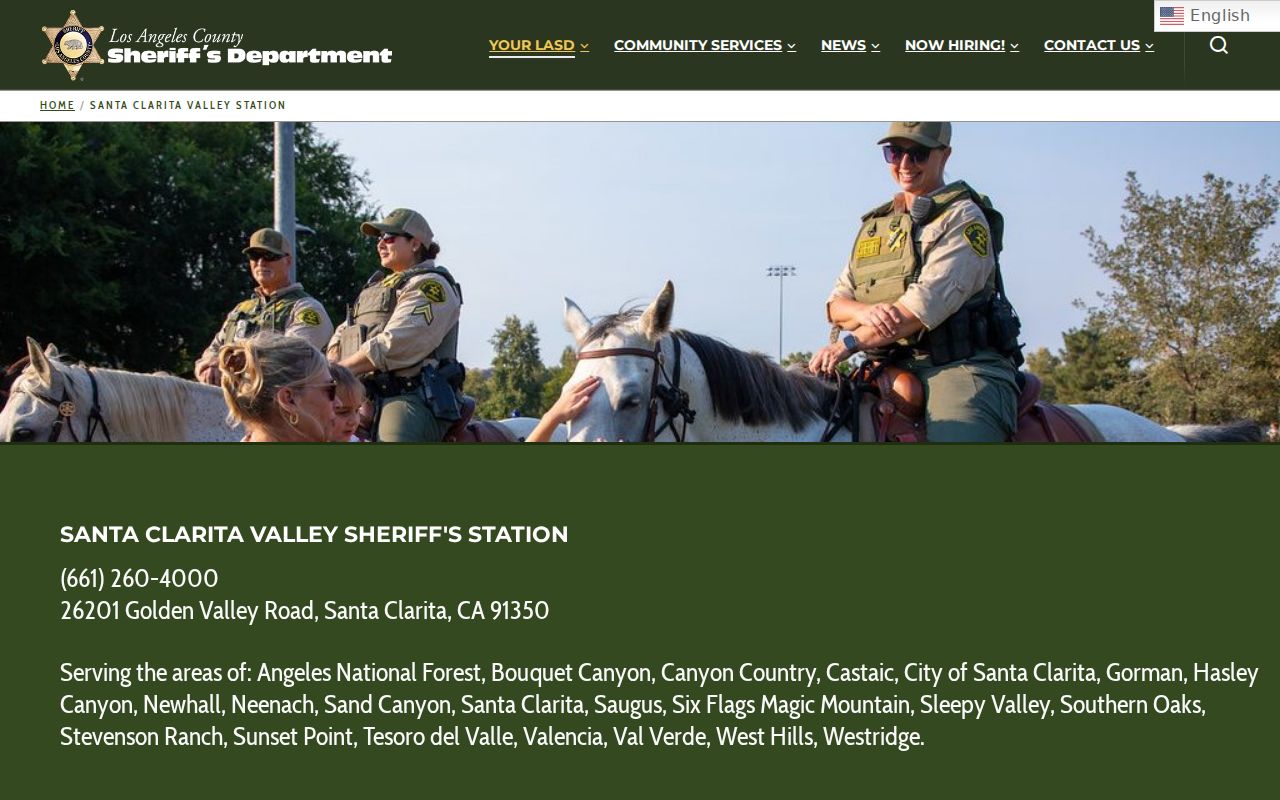
The station view confirms the correct law-enforcement provider for Santa Clarita. Use its counter or phone for a local starting point, LASD’s formal records channels for releasable copies, and the courthouse for judicial documents. Those routes may concern one event, but each office controls only its own record.
Santa Clarita Arrests and Bookings
A Santa Clarita arrest normally enters LASD custody systems because LASD provides local police service and operates the county jail network. Search the Inmate Information Center for current or recent county custody. The 24-hour 213-473-6100 custody line is another official route when a booking is new or an online result is unclear.
The locator does not provide a person’s entire Santa Clarita arrest history. It answers custody questions. For the arrest report, use the station and LASD records routes. Once charges are filed, use the Superior Court. If a later state-prison transfer occurs, CDCR CIRIS becomes the locator. The county arrest lookup explains each custody layer in more detail.
How Santa Clarita Arrest Data Moves
LASD may create the incident, arrest, booking, and custody records for the same Santa Clarita event, but those remain distinct record types. Booking captures intake identifiers, charges at arrest, housing, holds, and release facts when public. A sheriff report holds the agency narrative. Neither decides the final case outcome.
A prosecutor’s filing creates the court case. Charges can be added, reduced, or declined after the arrest. Later, court disposition reporting should update California DOJ’s controlled state summary history. A new Santa Clarita custody record can therefore exist before any docket appears, while an older DOJ entry can lag behind the court. Compare the dates and custodians before calling one source incorrect.
Municipal Court Records in Santa Clarita
Santa Clarita does not maintain a separate municipal criminal court. Cases route through the Superior Court of California, County of Los Angeles. The Santa Clarita Courthouse is at 23747 W. Valencia Boulevard, Santa Clarita, CA 91355. The county locator lists weekday hours of 8:30 a.m. to 4:30 p.m. and Criminal Court Service/Intake at (661) 253-7384.
| Court name | Superior Court of California, County of Los Angeles |
|---|---|
| Local courthouse | Santa Clarita Courthouse, 23747 W. Valencia Boulevard |
| Criminal intake | (661) 253-7384 |
| Lookup | LASC Criminal Case Access or court counter |
| File contents | Filed charges, events, pleas, disposition, and sentence when public |
Some Santa Clarita cases may be assigned to San Fernando or downtown depending on type and court assignment. Follow the location shown on the case rather than assuming every local arrest stays at the Valencia Boulevard courthouse.
Santa Clarita Court Route Surprises
A missing Santa Clarita courthouse result does not prove that no case exists. The case may be too new, assigned elsewhere in the North Valley system, transferred, sealed, or filed under a name variant. Search LASC Criminal Case Access by defendant name or case number, then check the courthouse stated on the result.
Bench-warrant questions also follow the court file because a judge issues the warrant. There is no single official public countywide warrant portal documented for Los Angeles County. Call the criminal intake line or the court connected with the case, and consider counsel when a warrant may be active. The sheriff station enforces warrants but may not disclose every detail by phone.
Where Santa Clarita Records Go
A Santa Clarita event starts with LASD rather than a city police agency. The sheriff creates the incident and arrest records and may also create county booking data. Prosecutors then decide whether to file in Superior Court. Fingerprint and disposition reporting later contributes to California DOJ’s state summary record.
Record flow: LASD Santa Clarita Valley Station › Los Angeles Superior Court › California Department of Justice
The chain explains why the City Clerk cannot supply a sheriff report and why LASD cannot certify the final judicial outcome. Use the source closest to the stage being researched. For state prison after sentencing, move to CDCR CIRIS. For your own full California record review, use DOJ’s fingerprint route rather than a public name query.
City Portal and Sheriff Reports
The Santa Clarita City Clerk provides a Public Records Portal for City records and an electronic records library. That access is useful for municipal administration, but the portal does not replace LASD’s criminal-report request process. A city contract for sheriff service does not make sheriff investigative records into City Clerk files.
The Santa Clarita City Clerk page explains the City’s portal and electronic-record access.
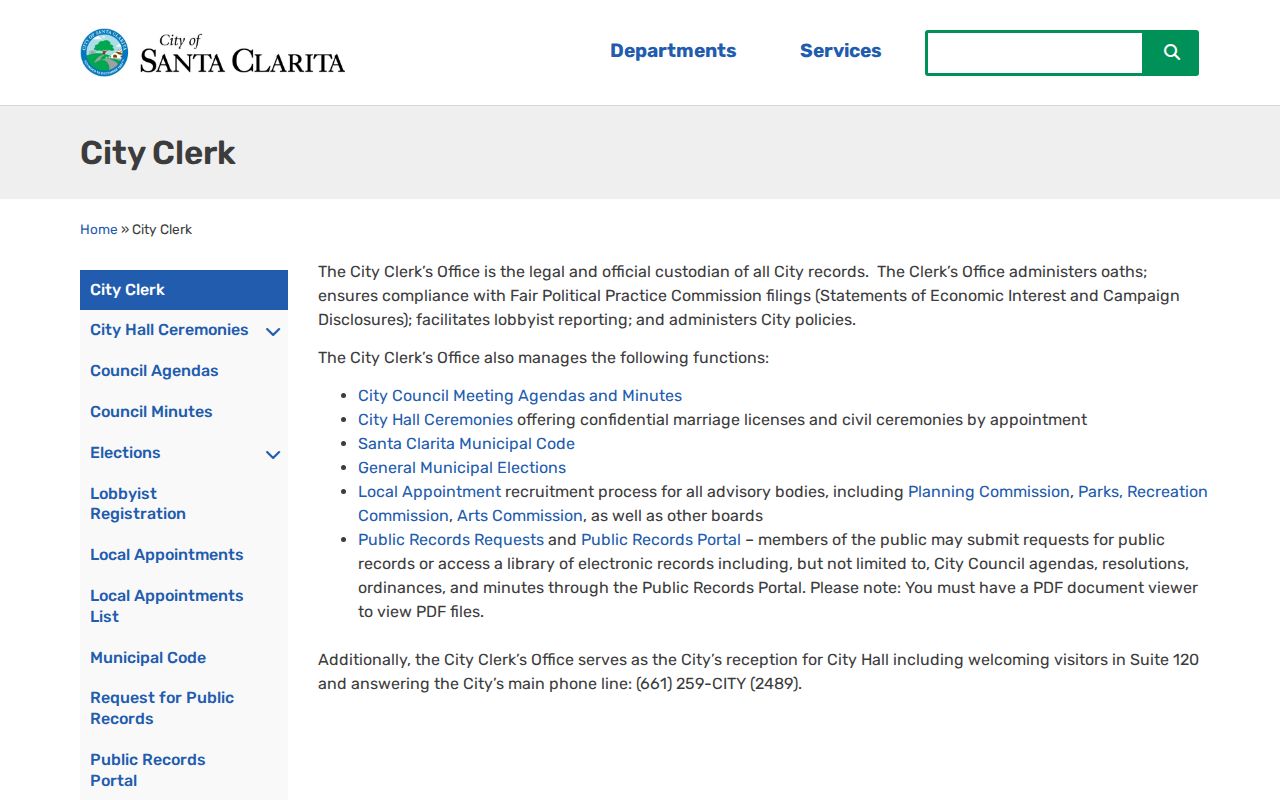
The portal image helps mark the boundary: use this City channel for Santa Clarita municipal documents, not a criminal report held by LASD. If a request involves both a city program and a sheriff incident, separate it into requests to the two legal custodians.
Santa Clarita Sheriff Zone Context
The City Manager describes a Sheriff Zone Program that monitors and addresses community-specific crime trends and issues. Santa Clarita also points to its collaboration with LASD and Fire in work intended to maintain quality of life and lower annual crime-rate statistics. This is local context, not a person-record search.
The LASD Crime Stats Dashboard supplies the department’s official statistical view.
The dashboard image shows the department’s official route for exploring trends by area and time. It cannot confirm an individual arrest, court charge, or conviction. For those facts, return to the station report, LASD custody data, and the LASC case file.
Calling the Station or Records Bureau
Call (661) 260-4000 when the question needs local station knowledge, such as which unit handled an event or where to begin. Use LASD Records and Identification or a formal CPRA route when the goal is a releasable copy, older custody detail, or a documented response. The station can route a caller, but the central records process may control production.
For a Santa Clarita court record, call Criminal Court Service/Intake at (661) 253-7384 instead. For current county custody, use LASD IIC or 213-473-6100. These phone choices are not interchangeable. State the document sought in the first sentence of the call, then provide the event date, location, case or report number, and involved name when lawful and known.
Public Access Rules in Santa Clarita
Santa Clarita records access depends on both custodian and law. The California Public Records Act applies to nonexempt agency records, including City and LASD material, but protected investigative information, juvenile data, victim details, and personal identifiers can be withheld or redacted. Court electronic records follow court rules. State summary history remains controlled information.
Key Statutes:
California Public Records Act provides access to nonexempt public records held by the responsible agency.
Penal Code section 11105 controls dissemination of California summary criminal history.
California Rules of Court, rule 2.503 governs reasonable public electronic court-record access unless a file is confidential or sealed.
Narrow a Santa Clarita request by date, location, document type, and responsible office. If an exemption covers only part, the public portion may be released with redactions.