
Checking Criminal History in Long Beach
A Long Beach search works best when it follows the document. LBPD can supply eligible police reports and answer records questions. LASD systems cover county custody, and the Superior Court covers filed criminal cases. California DOJ offers fingerprint-based review of one’s own state summary history, not a public name search.
- Check the LBPD blotter only for recent preliminary incident information.
- Request the actual police report from LBPD Information Management by mail or hand delivery.
- Use LASD Inmate Information Center or the custody line for a recent booking.
- Search Los Angeles Superior Court for filed charges, hearings, and disposition.
- Use California DOJ Live Scan Record Review for your own official state rap sheet.
Keep the report number, event date, location, and requester relationship close at hand. Those fields help LBPD identify the file and assess release. The county criminal-history guide gives more detail on state and county systems without replacing the local Long Beach steps.
LBPD Information Management Requests
The Long Beach Police Department directs report-copy requests to its Information Management Division at the Public Safety Building, 400 West Broadway, Long Beach, CA 90802. Download the department request form, then send it by mail or deliver it by hand. The form asks for facts that identify the incident and establish whether the requester can receive the material.
| Report number | Include it when known because it is the strongest lookup key. |
|---|---|
| Incident facts | Provide date and location to identify the report. |
| Requester details | Name, contact information, and relationship affect processing and release. |
| Delivery | Select mail or in-person handling on the form. |
| Internal status | Payment, release, mailing, and pickup boxes support staff processing. |
The report-copy helpline is (562) 570-7381, and the records desk is (562) 570-7475. Those numbers are more precise than calling emergency dispatch about a document request.
Long Beach Police Department Records
LBPD is the city agency for Long Beach incidents. Its headquarters is the Public Safety Building at 400 W. Broadway. The department lists (562) 435-6711 for non-emergency police response and (562) 570-7260 for business desk inquiries. A caller should choose the line by purpose: response and current police service differ from report-copy or records-desk work.
Police files can contain incident narratives, arrest facts, call details, video, or other investigative material, but eligibility and disclosure vary. Juvenile information, victim details, active investigative content, and other protected material may be redacted or withheld. A Long Beach police report also does not establish the later court result. Search the court after charges are filed.
LBPD Report Waits Can Be Long
LBPD warns that report processing varies with the incident and can take up to about six months. That practical warning is important for anyone who expects the copy to arrive as quickly as a blotter post. A request can require review, redaction, eligibility checks, and coordination with the responsible unit before release.
Do not repeatedly replace a pending request with broader requests. Keep the request number and contact channel, and use the report-copy helpline for status questions. If the immediate need is case status rather than the underlying police narrative, the Superior Court may already show a filing. If the issue is current custody, use the sheriff’s locator or custody phone line while the LBPD report remains in review.
Long Beach Arrests and Bookings
An LBPD arrest creates a city police record. The person may then appear in Los Angeles County Sheriff’s Department custody data, and a prosecution can later become an LASC case. The LASD Inmate Information Center is the online custody channel. The 24-hour 213-473-6100 line can also answer whether a person is held in an LAPD or LASD jail.
These sources answer different questions. The LBPD record explains the city incident and arrest. LASD shows custody information while the person is held or recently processed. LASC shows charges prosecutors actually filed and the later case history. For a full treatment of this distinction, consult the Los Angeles County arrest lookup. An arrest or booking is not proof of guilt.
Long Beach Blotter Is Preliminary
LBPD publishes a police blotter and news archive for prompt public information. Its blotter pages caution that entries are preliminary. A short item can change as investigators confirm facts, prosecutors review evidence, or the court receives different charges. It is not the certified report and not a court record.
The official LBPD blotter example shows how the department presents early incident summaries and its preliminary-information notice.
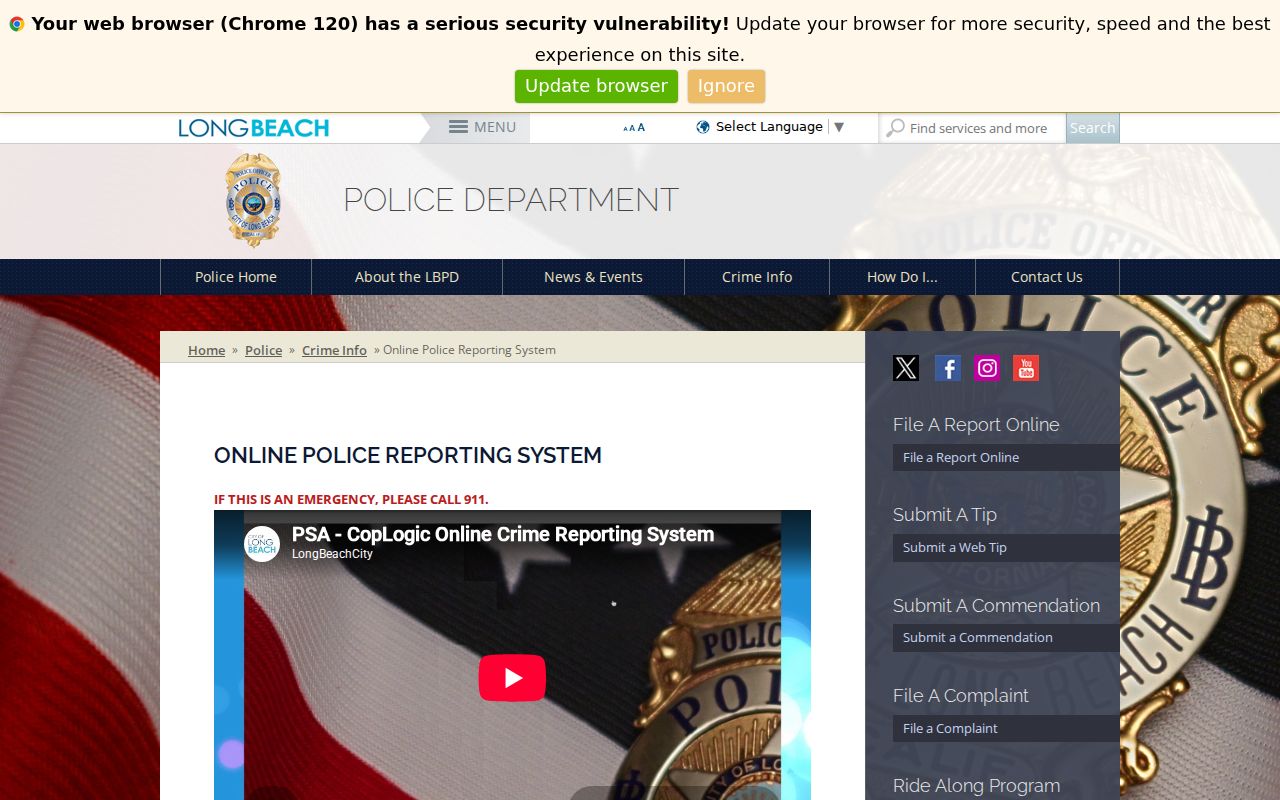
The online reporting view illustrates a separate function: residents can submit qualifying reports, but submission does not turn the public interface into a criminal-history database. Use a blotter item as a lead and request the proper record for verified detail.
Municipal Court Records in Long Beach
Long Beach has no separate city criminal court system for these prosecutions. Criminal filings route through the Superior Court of California, County of Los Angeles, including Long Beach-area court assignments. The web criminal search can locate a case by defendant name or case number, but the court warns that its online data is not an official record.
| Court name | Superior Court of California, County of Los Angeles |
|---|---|
| Case types | Felony and misdemeanor criminal cases and relevant infractions |
| Lookup channel | LASC Criminal Case Access and PAOS Criminal Defendant Index |
| Docket contents | Charges, court events, status, disposition, and sentence when public |
| Copies | Official copies must come from the court record channel |
LBPD’s arrest offenses may not match the filed counts. Read the complaint and docket for the prosecution’s actual case, and verify identity when a name search produces more than one Long Beach result.
LBPD PRA and Report Forms Differ
Long Beach separates routine police-report copies from broader police public-record requests. The report form and Information Management route are designed for incident-report copies. Requests for calls for service, 911 audio, video, or records covered by SB 1421 and AB 748 go through the City’s dedicated LBPD PRA channel at Long Beach public records requests.
Choosing the right Long Beach route at the start reduces transfers and clarifies which disclosure rules apply.
Where Long Beach Records Go
Long Beach records move from the city agency to county and state systems as the matter advances. LBPD creates the police report and arrest record. County custody creates a separate LASD booking layer. Prosecutors file eligible cases in LASC, and fingerprint and disposition reporting eventually feeds the California DOJ repository.
Record flow: Long Beach Police Department › Los Angeles Superior Court › California Department of Justice
A recent Long Beach incident may therefore appear in the blotter before a report copy is ready, and a booking may appear before the court has a filed case. The court disposition may later precede an update to a person’s DOJ rap sheet. Search by stage, and compare the records rather than treating one source as a complete chronology.
Long Beach Criminal Incident Dashboard
LBPD’s Criminal Incident Dashboard provides timely citywide and neighborhood crime statistics. It is useful for studying patterns by place or period, but it is not a person lookup. Statistical counts do not identify a defendant, confirm a booking, or establish a conviction. The dashboard is best read beside official explanatory material from LBPD.
The Long Beach crime statistics page is the source for the department’s dashboard and describes its local crime-data role.
The dashboard view shows why local context and personal records must remain separate. Use it to understand city trends, then use LBPD, LASD, or LASC for the record tied to a particular event or person.
Online Police Reporting in Long Beach
LBPD also operates an Online Police Reporting System for qualifying incidents. That service accepts reports that meet the department’s conditions. It is not an open archive of everyone’s Long Beach reports. A person submitting an event should review the eligibility instructions and use emergency or non-emergency response channels when the situation does not qualify.
Supplemental reports can be handled through the front desk at (562) 570-7260 or in person. Keep any temporary or assigned report number because it helps connect later material. A submitted report may still require review. If an arrest or prosecution follows, the custody and court records remain separate official layers, even though each arose from the same Long Beach event.
Public Access Rules in Long Beach
The California Public Records Act governs access to nonexempt LBPD and City records. It does not override protections for active investigations, juveniles, victims, private identifiers, or sealed material. Court electronic access follows court rules, while California DOJ summary history is controlled under Penal Code section 11105 and is not a public name database.
Key Statutes:
California Public Records Act opens nonexempt public records and permits legally required withholding or redaction.
Penal Code section 11105 limits access to state summary criminal history.
California Rules of Court, rule 2.503 controls reasonable remote access to public electronic court records.
A focused Long Beach request should identify the record type, date range, incident, and preferred form. If part is withheld, the releasable portion may still be produced with protected information removed.